
If you have a felony on your record and need a place to live, you do NOT need an article with fluff, false hope (clickbait), lies, or stupid advice.
You need a REAL plan, that produces REAL results. Here it is!
The Costly Mistake
The biggest mistake most felons make is applying blindly to apartment complexes, paying fee after fee, and getting denied with nothing to show for it except for empty pockets. A much smarter move is to target the right landlords, ask the right questions before you apply, and show up prepared with proof that you are stable, serious, and ready to be a good tenant.
There is no magic list of “felon friendly apartments” that will rent to you. Well there are a few but they are only clickbait. But many people with records do find housing, it just takes time, the right information and a solid plan.

Do you need Emergency Shelter or Housing? (If No Skip)
Across the United States and Canada, 211 connects people to local housing help and emergency services, HUD has a national directory for local public housing agencies, and HUD also provides a way to find housing counselors.
Need Housing Fast
If you are close to homelessness, stop worrying about the perfect apartment. Get safe first. Here are all of the emergency options available to you.
- Call 211 and ask for:
- emergency shelter
- housing navigation
- rent help
- utility help
- reentry housing
- transitional housing
- Contact local:
- shelters
- churches
- rescue missions
- reentry programs
- county assistance offices
- community action agencies
- Search for:
- room rentals
- weekly rentals
- shared housing
- transitional housing
- Call your local public housing agency and ask:
- whether there are any open waitlists
- whether they know of emergency housing partners
- whether they have reentry referrals
- what their current screening policy is
211 is built specifically to connect people with local housing and community services, and HUD provides the national tool to locate local housing agencies.
How Felons Can Actually Find Housing
You will not find housing by searching “felon friendly apartments near me” and getting lucky. This search will bring nothing to you but scams and generic information.
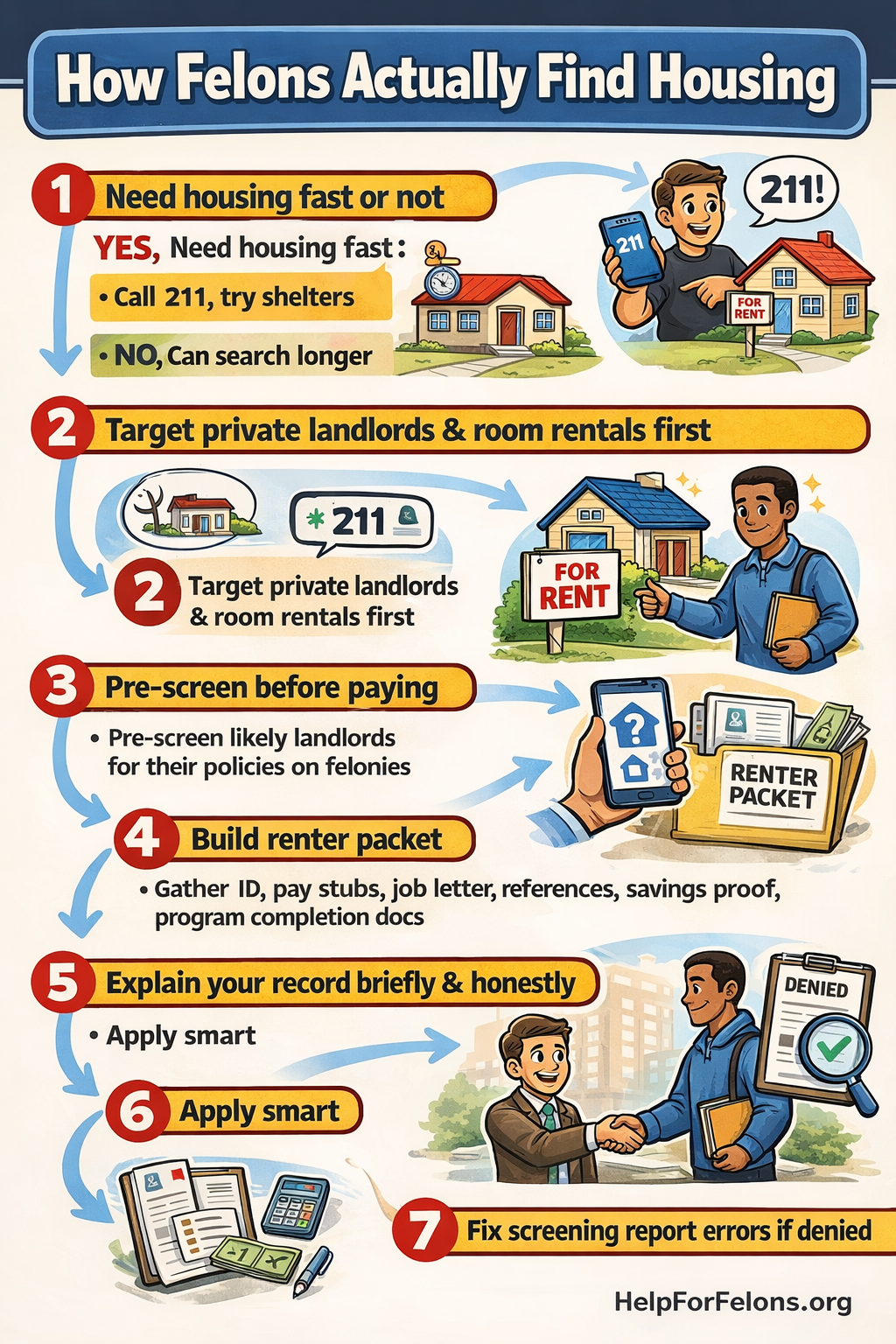
You will find housing by following a well thought out process that utilizes every avenue and resource possible. Here is an on overview of the process, next we will give you the details.
The real process
- Stop blind applying Every bad application costs money, time, and momentum. It also can make you really angry, kindly put.
- Target the right properties first Private landlords, room rentals, small buildings, and referral based housing usually give you a better shot than large corporate complexes.
- Pre screen before you pay Ask direct screening questions first. Never assume.
- Build a renter packet Make it easy for a landlord to see stability.
- Use every real resource you can 211, reentry programs, housing counselors, and local housing agencies exist for a reason.
- Have a denial plan If you get denied because of a tenant screening report, you may have rights to the report and the right to dispute errors.
That is how you stop wasting money and start moving forward.
Best Housing Types to Target First
1. Private landlords
This is usually the best place to start.
There are small time landlords, not a ton but some, that do not run background checks, obviously this is the easiest way to find an apartment. If they do run background checks a private landlord is more likely to listen to your story, look at your income, and make a real decision instead of relying only on a rigid corporate screening system. If you have it, extra cash or paying in cash can be a huge incentive.
There is an easy way to find private landlords in your area. Go to Apartments.com and set your filter to “Private Landlords.” Here are screenshots that show you hot to do that.

After clicking Filters. Near the bottom of that box you will see “Private Landlords or For Rent By Owner.” Go ahead and check that box.
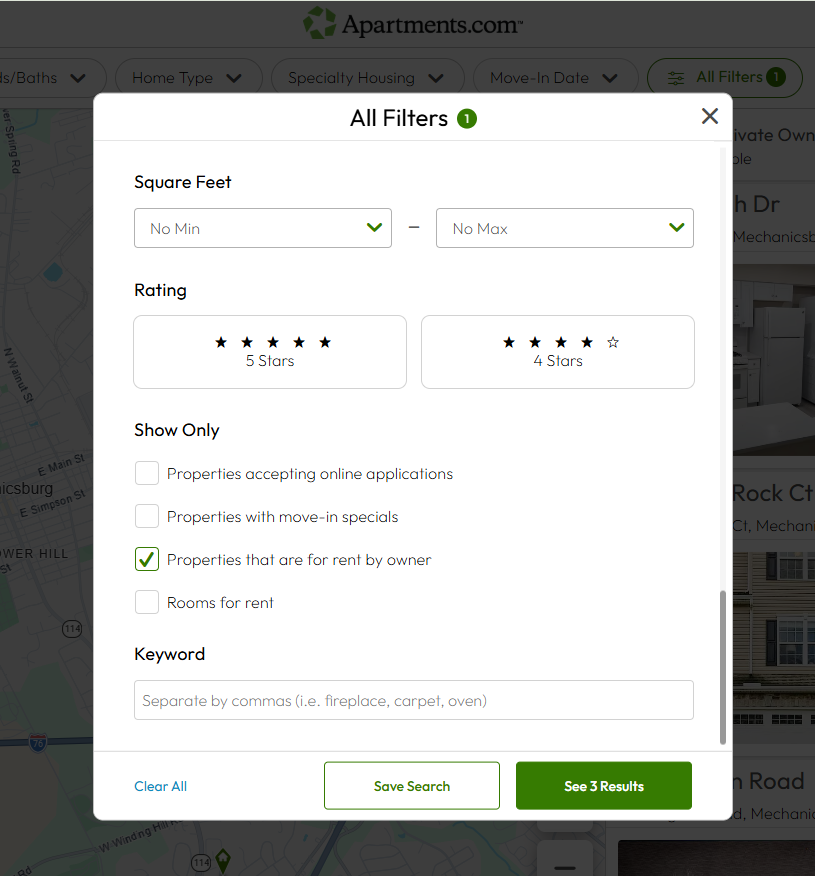
Now you are all set to search and see what you can find.
Also don’t forget about looking on Craigslist for apartments.
2. Room rentals & Sublets
Room rentals are often one of the fastest ways to find housing. They are usually cheaper, easier to qualify for, and can help you stabilize while you build savings and rental history. Yes, this is not the most appealing option but it builds history and solves your short term need. Keep looking if you end up doing this and get on some waiting lists.
Roomies is a good site to check out, as is Roomster. Also Check out Craigslist for rooms to rent. (Yes its still a thing).
3. Duplexes, triplexes, and older small buildings
These are often better targets than new apartment complexes. Many are owned by smaller landlords or local operators who are willing to talk. You can even talk to them about getting on a waiting list if they have no openings.
4. Reentry and transitional housing
These can be strong short term options, especially if you were recently released or have nowhere to go.
Your local 211 can connect people to emergency shelter, transitional housing, rent help, and local housing programs. Tell them you need reentry housing, transitional housing, halfway house options, sober living, or housing after incarceration.
The Federal Bureau of Prisons uses Residential Reentry Centers, often called halfway houses, to help people nearing release.
5. Public housing and voucher options
These are worth checking, but do not trust broad claims on random websites. Local housing agencies control a lot of the real details, and rules can vary. HUD provides the directory to find the right local office.
6. Hotels & Motels
There are hotels and motels that rent monthly, some are very affordable since everything is included. Look for your run of the mill motels, not the ones in the business district or touristy areas. Walk in and ask about monthly rates.
How to Pre Screen a Landlord Before You Pay
This section alone can save you hundreds of dollars. Before you apply, ask these questions:
- Do you run a criminal background check?
- Are all felonies automatic denials, or do you review people individually?
- Is there a lookback period?
- What matters most to you, violent charges, theft, fraud, property damage, drugs, evictions, or credit?
- Do you consider proof of rehabilitation, stable work, or references?
- Do you allow a co signer?
- What income do you require compared to the rent?
- Are evictions or bad credit a bigger concern than criminal history?
Do not ask these questions in person. Call ahead before you meet the landlord.
Simple phone script
Hi, before I pay an application fee, I wanted to ask a few screening questions. Do you screen for criminal convictions, and if so, are all felonies automatic denials or do you review each situation individually? I have stable income and references, and I just want to know whether it makes sense for me to apply.
That one conversation can save you a lot of wasted time and money.
Your Renter Packet
A renter packet can change the whole conversation. A lot of landlords are not just screening for a felony or criminal record. They are screening for risk.
Your packet should make them feel like you are organized, stable, and less risky than they expected.
What to include in your packet
You do not have to include all of this stuff but the more the better.
- Photo ID
- Two or three recent pay stubs
- Job offer letter, if you just started work
- Proof of any other steady income
- Bank statement or proof of savings, if available
- Previous landlord reference, if available
- Two personal references with phone numbers
- One page explanation letter about your record
- Proof of classes, treatment, counseling, or program completion, if relevant
- Proof of probation or parole compliance, if relevant
- Work certificates, training, or volunteer history that shows stability
- Proof you can pay the deposit and first month of rent
Why this matters
Landlords want to know the following.
- Will this person pay rent?
- Will this person damage the property?
- Will this person cause problems?
- Is this person honest?
- Is this person stable enough to trust?
A strong renter packet answers those questions before they even ask them.
Download a PDF of the Renters Packet Checklist.
What Landlords Actually Care About
A lot of people think landlords only care about the felony. That is not true. They care about risk as previously mentioned.
| What worries landlords | What makes them feel better |
|---|---|
| Late rent or no rent | Stable job and recent pay stubs |
| Property damage | Calm attitude and good references |
| Trouble with neighbors | Honest communication and signs of stability |
| Recent or relevant conviction | Time passed, changed behavior, proof of progress |
| Hidden problems | Straight answers and good paperwork |
If you reduce uncertainty, your odds go up.
What to Say About Your Record
Most people mess this up in one of two ways. They either say too little and seem shady, or they say way too much and sound desperate.
Keep it short, honest, and controlled.
Simple formula
- Briefly say what happened
- Take responsibility
- Explain what changed
- Show stability now
- Ask for a fair chance
Example explanation letter
I want to be upfront about my record. My conviction happened in [year]. Since then, I have worked hard to rebuild my life. I have steady income, I am focused on stability, and I can provide references. I understand why landlords are careful. I am asking to be considered based on who I am now, not only on my past.
That is enough. You do not need to tell your life story. You do not need to beg. You do not need to hide.
Public Housing and Voucher Help
This is one of the most misunderstood parts of housing.
There is not one simple national answer for whether someone with a felony can get public housing or a voucher. Local public housing agencies make many of the real decisions, and the rules can vary by program and location. HUD provides a national directory for those agencies.
HUD has also acknowledged that people with criminal histories often face unnecessary housing barriers and has encouraged more inclusive approaches, including looking at whether policies are truly needed and considering mitigating circumstances.
At the same time, HUD issued a 2025 notice rescinding its older arrest records notice and telling public housing agencies and federally assisted housing owners to follow current HUD regulations along with state and local law. That means the smartest move is to ask for the current written screening policy from your local housing agency instead of trusting old blog posts or outdated forum comments.
What to ask your local housing agency
- Is the waiting list open?
- What is your current screening policy?
- Do you review criminal history individually?
- Can I submit mitigating information?
- Can I appeal a denial?
- Do you know of any reentry or transitional housing options in the area?
What to Do If You Get Denied
If your rental application gets denied, do not just move on without asking questions.
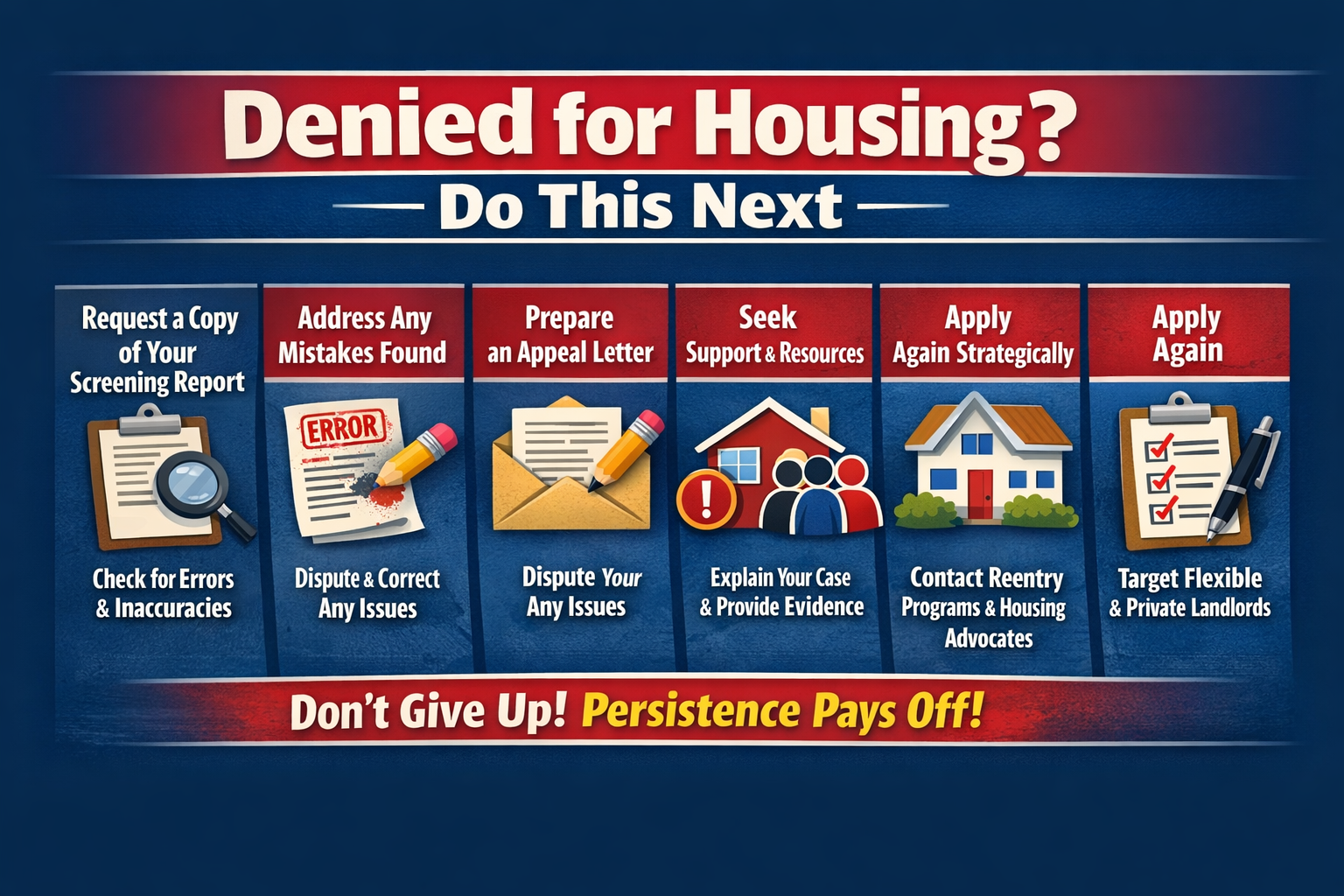
If the denial was based on a tenant screening report, the landlord must tell you that, identify the screening company, and tell you about your rights to get a free copy of the report if you request it within 60 days and to dispute inaccurate information.
Do this immediately
- Ask exactly why you were denied.
- Ask which tenant screening company was used.
- Request a copy of the report.
- Check it for:
- wrong identity information
- outdated records
- incorrect criminal information
- incorrect eviction information
- Dispute anything inaccurate right away.
- Ask whether the landlord will reconsider if the report is corrected.
This matters because screening reports are not always perfect, and bad data can block you from housing for no good reason. This also puts a bit of pressure back onto the landlord.
Common Mistakes That Get People Denied
1. Applying before asking screening questions
This is the fastest way to waste money.
2. Targeting only large apartment complexes
For many people with felony records, these are the hardest places to get approved.
3. Having no proof of income ready
Even a landlord open to your background may still deny you if the money side looks weak.
4. Oversharing
Be honest, but stay in control.
5. Ignoring credit and evictions
A felony is not always the only problem. In some cases, bad credit or a past eviction matters just as much or more.
6. Giving up too fast
One denial does not mean everyone will deny you.
7. Taking bad advice
Lying on applications, hiding your identity, or moving in without approval can turn a housing problem into an eviction problem.
Best Process for Finding Felon Friendly Apartments
If you remember nothing else from this page, remember this:
- Figure out how urgent your housing need is.
- Start with private landlords, room rentals, and small properties.
- Pre screen every property before paying.
- Build a renter packet before you start applying.
- Be honest, short, and calm about your record.
- Use 211, housing counselors, and local housing agencies when you need help.
- If you get denied because of a tenant screening report, get the report and dispute errors.
That is how people stop spinning their wheels and start making progress.
Felon Friendly Apartments & Housing FAQ
If they screen for criminal history, honesty is usually better. The key is to be brief, calm, and prepared. If they do not run background checks then you may not want to say anything.
That makes things harder, but not impossible. In that situation, room rentals, private landlords, stronger savings, and a good renter packet matter even more.
Sometimes yes, sometimes no. The real answer depends on the local housing agency, the program, and the facts of your case. Ask for the current written screening policy.
Sometimes yes. Not every landlord allows it, but some do. Ask before you apply.
Often it is a room rental, transitional housing, reentry housing, or emergency help through 211 and local service providers.
Other Helpful Resources
- Renters Insurance For Felons
- Felony Expungement Information
- Jobs For Felons
- Public Housing For Felons
- Reentry Programs by State
Always Remember
Finding housing with a felony record is hard, but it is not hopeless.
- The people who make progress are usually not the ones randomly applying everywhere.
- Target the right landlords.
- Ask the right questions first.
- Show up prepared.
- Use the help that is out there.
Keep moving. Everyone at Help For Felons wishes you only the greatest success and future!
Disclaimer
This page is for general informational purposes only and is not legal advice. Housing rules, screening policies, and landlord practices can vary by state, city, county, landlord, and housing program. Always verify the current policy directly with the property, screening company, housing agency, or a qualified housing counselor.