
Last Updated on: March 23, 2026
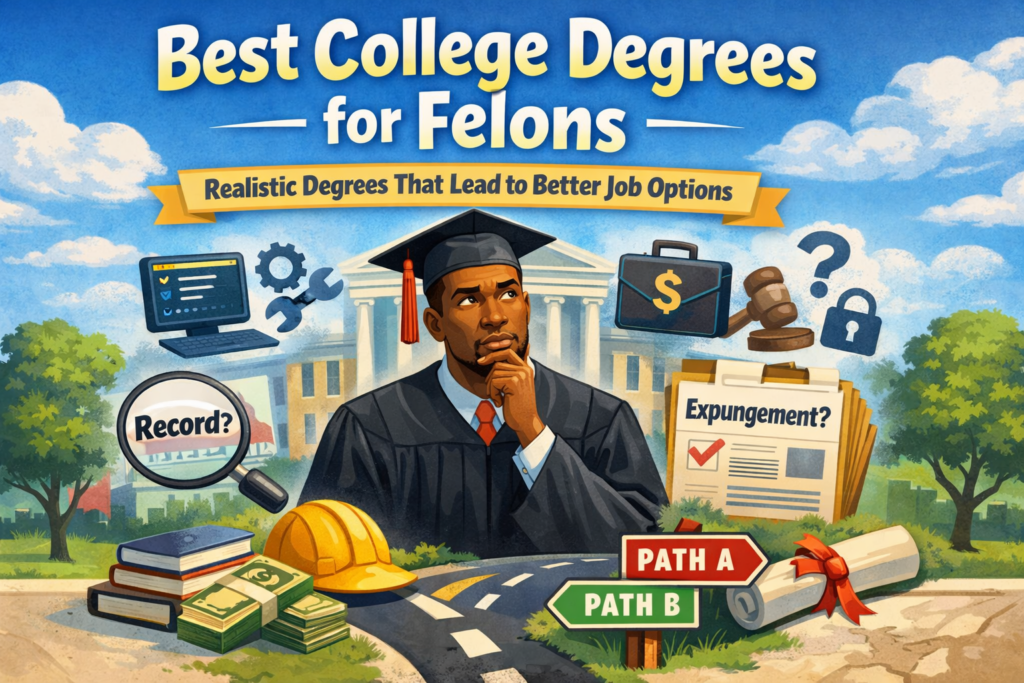
Going to college with a felony can still be a smart move, but only if you pick the right degree. That is where a lot of people mess up.
They choose a degree based on what sounds impressive, what someone else told them, or what they wish they could do, without stopping to ask one simple question:
Will this degree actually lead to realistic job options with my record? That is the real issue.
So the best college degrees for felons are usually not the flashiest ones. They are the ones that give you the most job options, the fewest legal or licensing barriers, and the best chance to turn school into real income.
What Makes a Degree Good for Someone With a Felony Record?
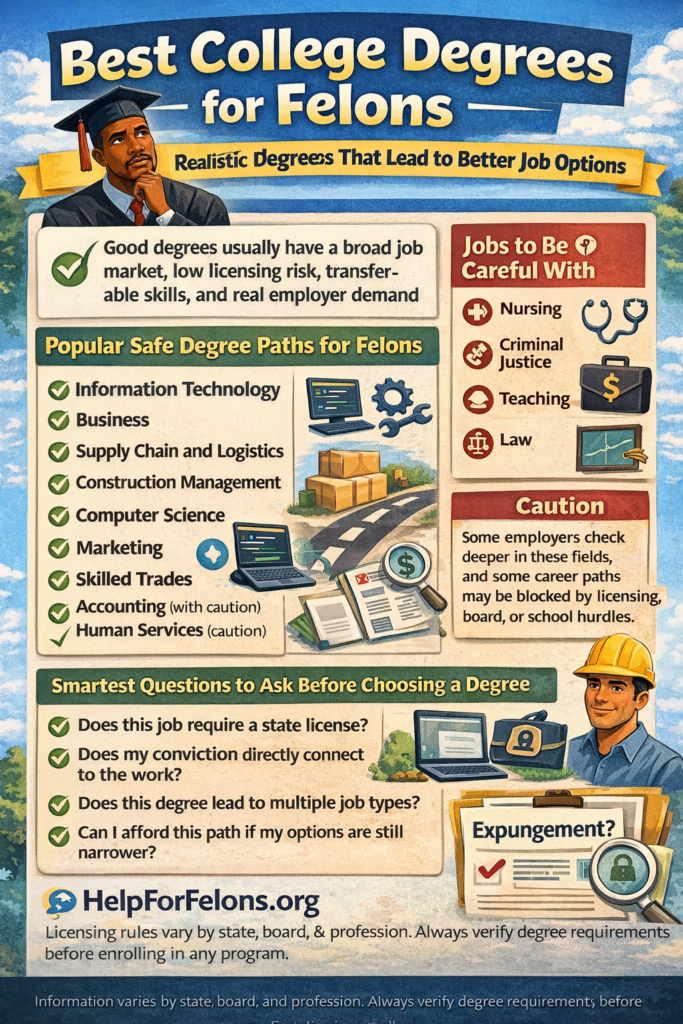
A degree is more useful if it checks most or all of these boxes:
| Factor | Why It Matters |
|---|---|
| Broad job market | More employers means more chances |
| No licensing Needed | Fewer board restrictions and fewer automatic barriers |
| Transferable skills | Skills can be used across different industries |
| Real employer demand | Better odds the degree leads to actual openings |
| Flexible career paths | If one role is blocked, others may still be open |
That is why this page is not just about the “best” degree in general. It is about the best degree for real life after a felony.
Can Expungement or Record Clearing Change Your Options? (Important)
In some cases, yes. This can be the ticket to being able to choose whatever degree you want.
If your record qualifies for expungement, sealing, a pardon, or another form of record relief, that could improve your options by the time you finish school. This matters because some degrees lead into careers where background checks, licensing reviews, and employer screening can create bigger barriers.
You should not choose a degree based only on the hope that your record will be cleared later. But you also should not ignore the fact that legal relief may change what is realistic for you in the future.
Talk to a lawyer BEFORE selecting your degree or starting school. You need to know whether you are going to have to work around the felony or if it can be expunged.
A degree path that looks risky right now may become more practical if your record is cleared or reduced in a way that helps with employment and/or licensing.
If record clearing may be possible in your state, read our expungement guide before choosing a degree path.
Best College Degrees for Felons
1. Information Technology (IT)
IT is one of the strongest degree paths for many felons because it can lead to a wide range of jobs and does not always rely on state licensing the way some other professions do.
Possible paths include:
• help desk
• network support
• systems support
• cloud support
• cybersecurity support
• IT operations
• junior analyst roles
Computer and information technology jobs are projected to grow faster than average from 2024 through 2034, according to the U.S. Bureau of Labor Statistics.
Why it can be a good fit
• broad field with many entry points
• some employers care more about skills than image
• certifications can help alongside a degree
• remote and hybrid roles may exist in some areas
Caution!
Some security focused jobs can be tougher if your record involves theft, fraud, hacking, or trust related offenses.
2. Business
Business is one of the safest all around degree choices because it is broad. You are not locking yourself into one narrow career path. A business degree can connect to operations, sales, management, customer service, logistics, small business ownership, and administrative work.
That flexibility matters a lot if you have a record.
Why it can be a good fit
• broad and practical
• useful in many industries
• helps if you want to move into supervision later
• useful if you may eventually start a small business
Best business related majors
• business administration
• management
• operations management
• entrepreneurship
• supply chain management
3. Supply Chain and Logistics
This is one of the most underrated degree paths for people with records.
Warehousing, shipping, inventory, transportation support, procurement support, and operations all connect well to this field. It can be especially smart for someone who already has work history in warehouse, production, or transportation settings.
Why it can be a good fit
• practical field tied to real world operations
• connects well to warehouse and distribution work
• can build on existing experience
• good path for moving from labor into coordination or supervision
Good fit for people who
• have already worked in warehouses
• like structured, practical work
• want a degree that leads to operations roles
4. Construction Management
Construction can be one of the better industries for people with records, and construction management can be a smart step up if you already understand physical work, crews, or job sites.
This path can lead to estimating, scheduling, project coordination, site supervision, and operations roles.
Why it can be a good fit
• builds on real world job site experience
• practical field with clear value
• can lead to higher paying roles over time
• less image driven than some white collar fields
Caution!
Some employers in this space may still screen heavily for certain records, especially where safety, government work, schools, or secure sites are involved.
5. Computer Science
Computer science is harder than general IT, but it can still be a strong option for some felons, especially if they are serious about software, problem solving, and technical work.
Why it can be a good fit
• strong long term upside
• useful across many industries
• can connect to freelance or contract work in some cases
• skill based portfolio can matter
Caution!
This is not the easiest degree. It takes real effort. Also, some employers in finance, defense, or security sensitive areas may be harder to access with certain convictions.
6. Marketing
Marketing is more useful than many people think, especially if the degree includes digital skills.
A good marketing path can lead to roles involving:
• content
• email marketing
• social media
• search engine optimization
• ad support
• sales support
• brand support
Why it can be a good fit
• broad field
• some employers care more about results than background
• can pair well with freelance work or self employment
• useful if you ever run your own business
7. Accounting, With Caution
Accounting or CPA can still be a good degree, but this one depends a lot on the conviction. If someone has fraud, embezzlement, theft, or other money related offenses, this path may be much harder or impossible. You must research this heavily in the state you will be licensed in!
Still, not every accounting related role is the same. There are bookkeeping, payroll, back office, tax prep support, and internal support roles that may be more accessible than high trust finance jobs.
Why it can still be useful
• strong practical skill
• needed by many businesses
• stable office related path
• useful even for self employment
Caution!
This degree is much riskier if your record directly involves dishonesty or financial misconduct.
8. Human Services or Social Services, With Caution
This path can be meaningful for people who want to help others and use their past to do something better.
Possible roles may include:
• case management support
• peer support roles
• nonprofit support work
• outreach work
• reentry support work
• community services work
Why it can be a good fit
• mission driven
• lived experience can matter
• can lead to meaningful work
• fits some reentry and nonprofit settings well
Caution!
Some positions require licenses, certifications, or agency screening. Some roles involving children, vulnerable adults, or regulated settings may be harder depending on the record.
9. Skilled Trades – A great Option
Not every good education path has to be a traditional four year degree. For many felons, a trade program, technical program, or applied associate degree may be a better decision than a bachelor’s degree.
Examples include:
• HVAC
• welding
• industrial maintenance
• electrical technology
• drafting
• manufacturing technology
• diesel technology
Why this matters
For some readers, the best “college degree” is actually a shorter, more practical training path that leads to faster income.
10. Entrepreneurship
This is not the safest pick for everybody, but for the right person it can make sense. If your record makes employers hesitate, building your own income stream may matter more than trying to impress a hiring manager forever.
An entrepreneurship or small business focused degree can help with:
• accounting basics
• marketing basics
• operations
• sales
• planning
• managing cash flow
Caution
Do not choose this just because you are frustrated with employers. Starting a business is hard. This works best when paired with a real skill.
Degrees to Be Careful With
Some degrees can still work for some people with records, but they come with more risk. Here is where people need to slow down and do homework before spending money.
| Degree Area | Why You Need to Be Careful |
|---|---|
| Nursing | Licensing and clinical placement can be major issues |
| Teaching | School settings and child related screening can create barriers |
| Law | Bar admission rules vary and character reviews can matter |
| Criminal justice | Degree may not help much if your goal is law enforcement |
| Medicine | Licensing and clinical barriers can be serious |
| Pharmacy | Heavy regulation and trust concerns |
| Social work | May require licensing depending on role |
| Finance | Money related convictions can create major barriers |
This does not mean impossible. It means you should never assume a degree is safe just because the school will accept your tuition. Make sure you do your research!
What About Grants and Financial Aid?
Many people with records wrongly assume college aid is off limits. That is not always true.
Federal Student Aid says students who are confined or incarcerated may now have access to Pell Grants if they are enrolled in an approved prison education program, although incarcerated students are not eligible for federal student loans.
Federal Student Aid (FAFSA) remains the main application for grants, loans, and work study, and some conviction related issues can still affect aid in certain situations. So do not assume you are out of options.
You should also read:
• Pell Grants for Felons
• Scholarships for Felons
• Loans for Felons
• Financial Information
Best Degree Choices by Situation
| Your Situation | Stronger Degree Options |
|---|---|
| Want broad job options | Business, IT, marketing, supply chain |
| Already work in warehouse or labor | Supply chain, construction management, business |
| Good with computers | IT, computer science |
| Want practical fast training | Trade related programs, technical associate programs |
| Want to help people | Human services, community services, counseling support related study |
| May want your own business | Business, marketing, entrepreneurship |
Final Verdict
The best college degree for a felon is usually not the one that sounds the most impressive. It is the one that gives you the best shot at real work.
For a lot of people, that means choosing a degree that is broad, practical, and flexible. Business, IT, supply chain, construction management, marketing, computer science, and some trade or technical programs are often stronger bets than degrees tied to heavy licensing or tightly restricted professions.
Pick the path that gives you options. That is what matters most.
Best College Degree FAQ
There is no perfect answer, but broad degrees like business, IT, and supply chain are often safer because they lead to many kinds of jobs.
Be careful with degrees that lead into heavily licensed fields or jobs involving children, controlled substances, high trust financial roles, or strict government screening.
Sometimes, yes. For many people, trade school or a technical program is faster, cheaper, and more practical than a four year degree.
Disclaimer
Education, licensing, and hiring rules vary by state, school, licensing board, employer, and type of conviction. Information on this page is for general informational purposes only and is not legal advice. Always verify degree requirements, licensing rules, and job restrictions before enrolling in any program.