
Last Updated on: March 26, 2026
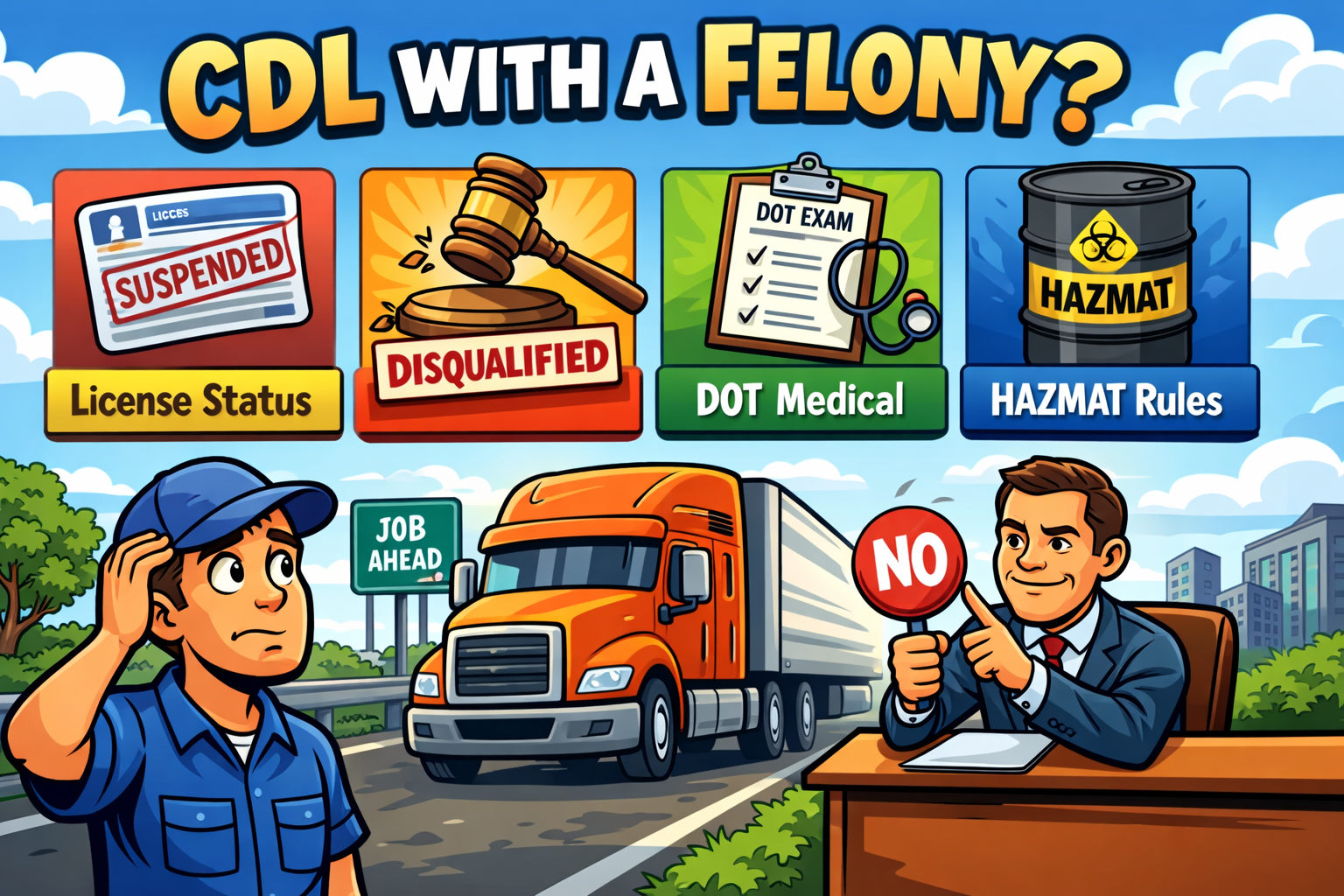
In many cases, yes, you can still get a CDL with a felony. A felony by itself does not automatically block every person from getting licensed. But there are still major things that can stop you, including a suspended license, certain CDL disqualifying offenses, failure to pass the DOT medical exam, or extra restrictions tied to a HAZMAT endorsement.
Even if you can legally get the license, that does not mean every trucking company will hire you. That is where many people get confused. Getting a CDL and getting hired are related, but they are not the same thing.
Quick Answer
Yes, many felons can get a CDL. The biggest problems are usually not the felony alone. The real blockers are things like a revoked or suspended license, federal CDL disqualifications, certain serious driving offenses, certain controlled substance felony rules tied to commercial vehicles, failing the DOT medical exam, or getting denied for a HAZMAT endorsement.
Does a felony automatically stop you from getting a CDL?
No. In many cases, a felony does not automatically stop you from getting a CDL. That is the good news.
The bad news is that some people focus too much on the word “felony” and not enough on the things that actually cause CDL trouble. In real life, these are the issues that matter most:
- Your regular driver’s license status.
- Whether you are under a CDL disqualification.
- Whether you can pass the DOT medical exam.
- Whether you want or need a HAZMAT endorsement.
- Whether employers will hire you after licensing.
So if you have a felony but your license is valid, you are not under a disqualifying offense period, and you can pass medical, you may still be able to move forward.
What can actually stop you from getting a CDL?
Here is the part most people need explained clearly.
1. Your license is suspended, revoked, withdrawn, or denied
Federal rules make clear that a driver is disqualified for as long as they lose the privilege to operate a commercial motor vehicle because of a revoked, suspended, withdrawn, or denied license, until that privilege is restored.
That means if your driving privileges are not fixed yet, this usually needs to be handled before your CDL path makes sense.
2. You are under a CDL disqualification for a major offense
Federal CDL rules list major offenses that can trigger disqualification periods. These include things like DUI, leaving the scene of an accident, refusing alcohol testing, using a vehicle in the commission of certain felonies, or causing a fatality through negligent operation of a commercial motor vehicle. The exact penalty depends on the offense and whether it happened in a CMV or, in some cases, a non CMV.
3. Controlled substance felony rules can be severe
FMCSA states that using the vehicle in the commission of a felony involving manufacturing, distributing, or dispensing a controlled substance is one of the major offenses tied to CDL disqualification, and states must impose a lifetime disqualification in that situation under the federal framework.
This is a very important point. Not every drug felony creates the same CDL result. The details matter.
4. You cannot pass the DOT medical exam
A CDL is not just about your criminal record. It is also about whether you are medically qualified to operate a commercial motor vehicle. FMCSA states that interstate CMV drivers must maintain a current Medical Examiner’s Certificate, and a DOT physical can be valid for up to 24 months, though it may be issued for a shorter period when a condition needs monitoring.
This matters because some people spend money on CDL school before checking whether the medical side will stop them.
5. You are really asking about HAZMAT
A basic CDL and a HAZMAT endorsement are not the same thing. TSA applies separate disqualifying offense rules to HAZMAT endorsements, and some people who may still qualify for a regular CDL could have a problem getting HAZMAT.
CDL Vs. HAZMAT endorsement
A basic CDL may still be possible for many people with felonies. A HAZMAT endorsement is tougher. TSA has its own list of disqualifying criminal offenses and other factors for HAZMAT endorsement eligibility.
Can trucking companies still deny you even if you get the CDL?
Yes. This is where many people get frustrated. You might be legally able to get the license, but still have trouble getting hired. That is because employers can set their own hiring standards, as long as they follow the law. A trucking company may look at:
- The type of felony.
- How recent it was.
- Whether it involved violence.
- Whether it involved theft or fraud.
- Whether it involved drugs.
- Your driving record.
- Whether you have probation or parole restrictions.
- Whether the job involves border crossing, HAZMAT, or sensitive cargo.
The best way to think about this
There are really three separate hurdles:
| Hurdle | What it means |
|---|---|
| Legal eligibility | Can you get or hold the CDL under federal and state rules? |
| Medical eligibility | Can you pass the DOT physical and stay medically certified? |
| Hiring eligibility | Will an actual trucking company hire you with your record? |
What to check before paying for CDL school
This can save you money!
Check this first
- Make sure your normal license is valid. If your regular driving privileges are suspended or revoked, that is a major red flag.
- Find out whether you are under any CDL disqualification. Major offenses can block you for a period of time, and some controlled substance felony situations can be much worse.
- Get clear on the DOT medical exam. FMCSA requires current medical certification for interstate commercial drivers, and a failed medical issue can stop the plan before it starts.
- Decide whether you actually need HAZMAT. If HAZMAT is the problem, you may still be able to build a career without it.
- Talk to real employers before paying tuition. This is one of the smartest steps. Do not assume that because a school will take your money, a carrier will hire you afterward.
Can probation or parole affect your CDL plans?
Yes, sometimes. This is not always a federal CDL issue by itself. It can be a supervision issue. Travel restrictions, curfews, county limits, reporting requirements, and employer approval rules can all affect whether you can actually work as a driver, especially for over the road jobs.
That means some people may be able to get the license but still be better off targeting local work first.
Disclaimer
CDL rules, endorsements, employer policies, and state procedures can change. This page is for general informational purposes only and is not legal advice. Always verify your status with your state licensing agency, CDL school, probation or parole officer if applicable, and any employer you are considering.