
Last Updated on: April 15, 2026
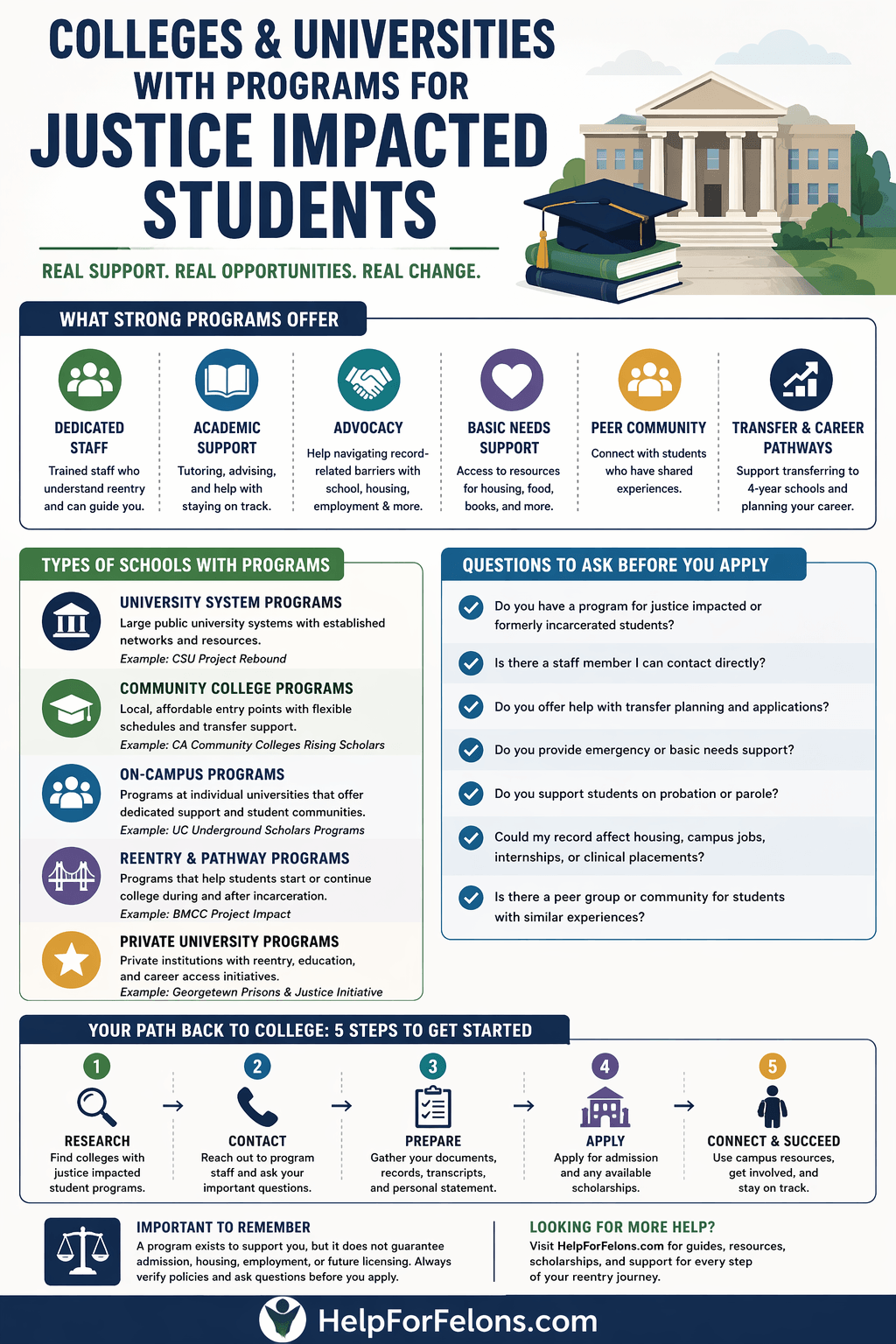
A growing number of colleges and universities now have real programs for justice impacted, formerly incarcerated, and system impacted students. The strongest programs do more than just admit you. They help with transfer planning, advising, tutoring, peer support, scholarships, basic needs, wellness, and advocacy when a criminal record creates barriers around school, work, housing, or reentry.
Who This Page Is For
This page is for:
- People coming home who want to start college
- Students with a record who want to transfer to a better school
- Parents, case workers, parole staff, and reentry workers helping someone find a college
- Anyone looking for a campus that offers more than a basic admissions answer
What Counts as a Real Program
We focus on schools that offer actual support for justice impacted students, not just a criminal justice major or a one time event. The programs below describe services like recruitment, retention, academic support, transfer guidance, scholarships, wellness support, advocacy, and reentry help.
Colleges and Universities Worth Checking First
Large public systems and statewide networks
- California State University, Project Rebound
Project Rebound operates across 19 CSU campuses and is one of the largest university based support networks in the country for formerly incarcerated students. - California Community Colleges, Rising Scholars Network
Rising Scholars supports justice impacted students at 49 colleges and nearly 20,000 students annually, while also connecting with prison education programming.
University of California campuses with dedicated support
- UC Berkeley, Berkeley Underground Scholars
Berkeley says its program creates a pathway for incarcerated, formerly incarcerated, and system impacted individuals into higher education. It describes its work as recruitment, retention, advocacy, wellness, and career services, and it prioritizes support for formerly incarcerated students. - UCLA, Bruin Underground Scholars
UCLA says BUS supports formerly incarcerated and system impacted students through scholarships, stipends, tutoring, peer coaching, leadership development, campus space, and advocacy. UCLA also says the program helps students dealing with barriers tied to education, employment, housing, benefits, and parole or probation. - UC Davis, Underground Scholars Program
UC Davis says it supports students directly impacted by the criminal punishment system, including formerly incarcerated students and students with incarcerated family members. The program also offers transfer advising, application support, and grants for housing, food, clothing, books, and supplies. - UC Irvine, Underground Scholars Program
UCI says its program creates a pathway into higher education and provides recruitment, retention, advocacy, and wellness support for incarcerated, formerly incarcerated, and system impacted students. - UC San Diego, Triton Underground Scholars
UC San Diego says TUS supports formerly incarcerated and system impacted students through community, wellness, academic support, advocacy, outreach, recruitment, and retention programming.
Community college and reentry focused options
- Borough of Manhattan Community College, Project Impact
BMCC says Project Impact serves justice involved students seeking education, economic opportunity, and a different path forward. BMCC and John Jay also describe their Prison to College Pathways program as reentry based, with students starting their CUNY education while incarcerated and continuing it after release. - Middlesex College, Center for Justice Impacted Students
Middlesex says its Center for Justice Impacted Students advances higher educational opportunities for justice impacted students and serves as a resource hub and support center for formerly incarcerated and justice impacted students. Its Justice Scholars Program gives students structured support on campus.
Private university option with a strong reentry focus
- Georgetown University, Prisons and Justice Initiative
Georgetown says its Prisons and Justice Initiative leads education and training in prisons and promotes successful reentry by supporting access to college and careers.
What This List Tells You
A few clear patterns show up.
First, California is one of the strongest places in the country for justice impacted student support because it has both a large university network through Project Rebound and a major community college network through Rising Scholars.
Second, the University of California system has built multiple campus programs around the Underground Scholars model. That matters because it gives students several transfer and destination options instead of just one school.
Third, community colleges can be one of the best starting points if you need a lower cost entry point, local support, a second chance after time away from school, or a transfer path into a four year university. That is especially clear in programs like Rising Scholars, BMCC Project Impact, and Middlesex College’s Center for Justice Impacted Students.
Best Fit by Situation
| Your situation | Best type of school to check first | Why |
|---|---|---|
| You need the easiest on ramp back into school | Community college with a justice impacted support program | Lower cost, closer to home, more flexible entry, and often stronger day to day support |
| You want to transfer into a major public university later | Community college plus a transfer focused program | Several programs explicitly help with transfer advising and application support |
| You need a campus that understands parole, probation, or reentry barriers | Schools with dedicated advocacy support | Some programs specifically mention helping students navigate record related barriers |
| You want a strong student community, not just paperwork help | Underground Scholars style programs | These programs often combine community, wellness, and academic support |
| You are starting while still incarcerated or coming home soon | Prison to college pipeline or reentry based programs | These are built for the transition period, not just traditional students |
How to Compare Schools the Right Way
Do not just ask, “Do you accept people with records?”
Ask these questions instead:
- Do you have a dedicated program for justice impacted, formerly incarcerated, or system impacted students?
- Is there a staff member whose job includes helping these students?
- Do you offer emergency grants, food help, housing help, or textbook help?
- Do you help with transfer planning, transcripts, and personal statements?
- Will my record affect student housing, campus jobs, internships, or field placements?
- Do you help students who are on parole or probation?
- Is there a student group or peer community for people with lived experience like mine?
Those questions matter because even strong campuses may still have separate barriers around housing, campus jobs, benefits, or administrative review. Some of the best programs openly say advocacy is part of the work, which tells you these barriers are real and worth asking about up front.
What to Search If a School Does Not Use the Term “Justice Impacted”
A lot of schools do not use the exact same language. Try searching the school name with phrases like:
- formerly incarcerated students
- system impacted students
- Underground Scholars
- prison education
- reentry program
- student support center
- basic needs support
- transfer support
That will usually get you closer to the real answer than a generic admissions page.
Important Truth
A college having a support program does not guarantee admission, housing, campus employment, clinical placement, internship placement, or professional licensing later. It simply means the school has some level of structure to help students navigate those issues.
That is still valuable, but you should treat it as a sign of support, not a promise of outcomes. The safest move is to contact the program directly before applying and ask about your exact situation.
Other Helpful Guides & Information
You may also want to read:
- Grants for Felons
- Pell Grants for Felons
- Pell Grants for Inmates: Who Qualifies and How to Apply Now
- Best College Degrees for Felons
- Financial Help For Felons
- Loans For Felons
- Scholarships For Felons
- Felony Expungement and Record Sealing
- Felon Friendly Apartments & Housing: How to Find and Get Approved
- Can Felons Get Public Housing or Section 8? What HUD Rules Say
- Resources For Felons
Bottom Line
If you have a criminal record and want to go back to school, do not assume every campus will understand what you are dealing with. Look for schools that already built something real for justice impacted students. Right now, some of the strongest public examples include the California State University Project Rebound network, California Community Colleges Rising Scholars Network, several University of California Underground Scholars programs, BMCC Project Impact, Middlesex College’s Center for Justice Impacted Students, and Georgetown’s Prisons and Justice Initiative.
The best school for you is not just the one that says yes. It is the one that has people, systems, and support already in place when real life gets complicated.
FAQ
Is this a full list of every college with a program for justice impacted students?
No. This is a strong starting list, not a full national directory. Programs change, new ones launch, and some schools do a poor job of making them easy to find online.
Are community colleges a good place to start after release?
Yes. In many cases, community colleges are one of the smartest entry points because they are lower cost, more local, and often connected to transfer pathways and day to day support services.
Do these programs only help formerly incarcerated students?
Not always. Some schools also serve system impacted students, which can include people affected by arrest, conviction without incarceration, or incarceration of a close family member.
Does a support program mean the school is easy for everyone with a record?
No. It means the school has at least some structure to help. Policies around housing, jobs, internships, and certain career tracks can still create barriers.
Disclaimer
Programs change. Names change. Eligibility rules change. Always verify details directly with the school before you apply, enroll, or rely on a program for housing, financial aid, or reentry planning. Nothing on this page should be considered legal advice.