
Last Updated on: 03/24/2026
Quick Answer
Yes, some people with felony convictions do become nurses, but this is not a simple yes or no issue. The real answer depends on your state board of nursing, the type of offense, how long ago it happened, whether you finished every part of your sentence, and what proof of rehabilitation you can show. Some states review applications case by case. Some states have hard eligibility limits. A compact multistate license can also be tougher to get than a regular single state license.
Can a felon become a nurse?
Sometimes, yes. But there are three separate hurdles:
- Getting into nursing school
- Getting approved by the state board for licensure
- Getting hired after licensure
A lot of people confuse these steps. That is a mistake. Even if a school lets you enroll, that does not guarantee the board will approve your nursing license later. Texas is a good example. Its Board of Nursing has a Declaratory Order process specifically for people with eligibility issues that could stop them from taking the NCLEX or getting licensed.
Can a felon go to nursing school?
In many cases, yes.
Getting into school is often easier than getting licensed. A program may accept you, but the state board is the one that decides whether you can become a licensed nurse. That is why this career can be risky if you start school without checking your licensing chances first.
Example: Texas openly tells applicants to use the Declaratory Order process when there may be an eligibility problem.
Can a felon get a nursing license?
That depends on the state.
California applicants with criminal conviction records can be issued a license, and those applications are reviewed case by case. California also says there is no single conviction type that automatically disqualifies every applicant. At the same time, the Board reviews whether the offense is substantially related to nursing, and it looks at severity, recency, compliance with sanctions, and evidence of rehabilitation.
Arizona is stricter. It says an applicant is not eligible if they have felony convictions and have not received an absolute discharge from all felony sentences 3 or more years before submitting the application.
So the real answer is this: some states allow case by case review, while others have harder rules that can stop you before the board even gets to the rest of your file.
What nursing boards usually look at
If your record is going to be reviewed, the board will usually care about questions like these:
- What was the offense?
Violent conduct, abuse, theft, fraud, controlled substance offenses, and crimes involving trust or patient safety are usually much harder to overcome. California specifically lists assaultive or abusive conduct, theft, dishonesty, fraud, deceit, and certain registrable offenses as substantially related to nursing. - How long ago did it happen?
Time matters. California says it generally will not take action on convictions older than seven years or on expunged convictions under its law, with exceptions for serious felonies and certain sex offense registration crimes. - Did you finish everything?
Boards care about whether probation, parole, restitution, counseling, treatment, fines, and all other sentence requirements were completed. Arizona specifically requires proof of absolute discharge for felony sentences. - What have you done since then?
Boards want to see rehabilitation, stable work, schooling, treatment, clean time, community involvement, and strong references. California lists these types of evidence directly. - Were you honest?
Failing to disclose can hurt you badly. California says failure to disclose convictions may itself become a problem.
Felonies with the worst odds
Some records are much tougher than others. The hardest cases usually involve offenses that directly raise patient safety, trust, or abuse concerns. That often includes:
- Violent offenses
- Abuse related offenses
- Theft, fraud, dishonesty, or deceit
- Drug distribution or serious controlled substance cases
- Sex offense registration type cases
That does not mean every applicant with one of these records is automatically denied in every state. But it does mean you should expect much heavier scrutiny. California’s published standards make that clear.
Single state license versus compact license
A person may still have some chance at a single state license in certain states, but a compact multistate license is often harder. Under the Nurse Licensure Compact uniform licensure requirements, an applicant for a compact license must not have been convicted or found guilty of a felony offense, and official compact guidance says felony convictions may disqualify a person from a compact license.
That means someone may face this situation:
- Maybe eligible for review in one state
- Maybe able to get a single state license there
- Still not eligible for a compact multistate license
That distinction matters a lot if you want travel flexibility or remote crossing of state lines in nursing work.
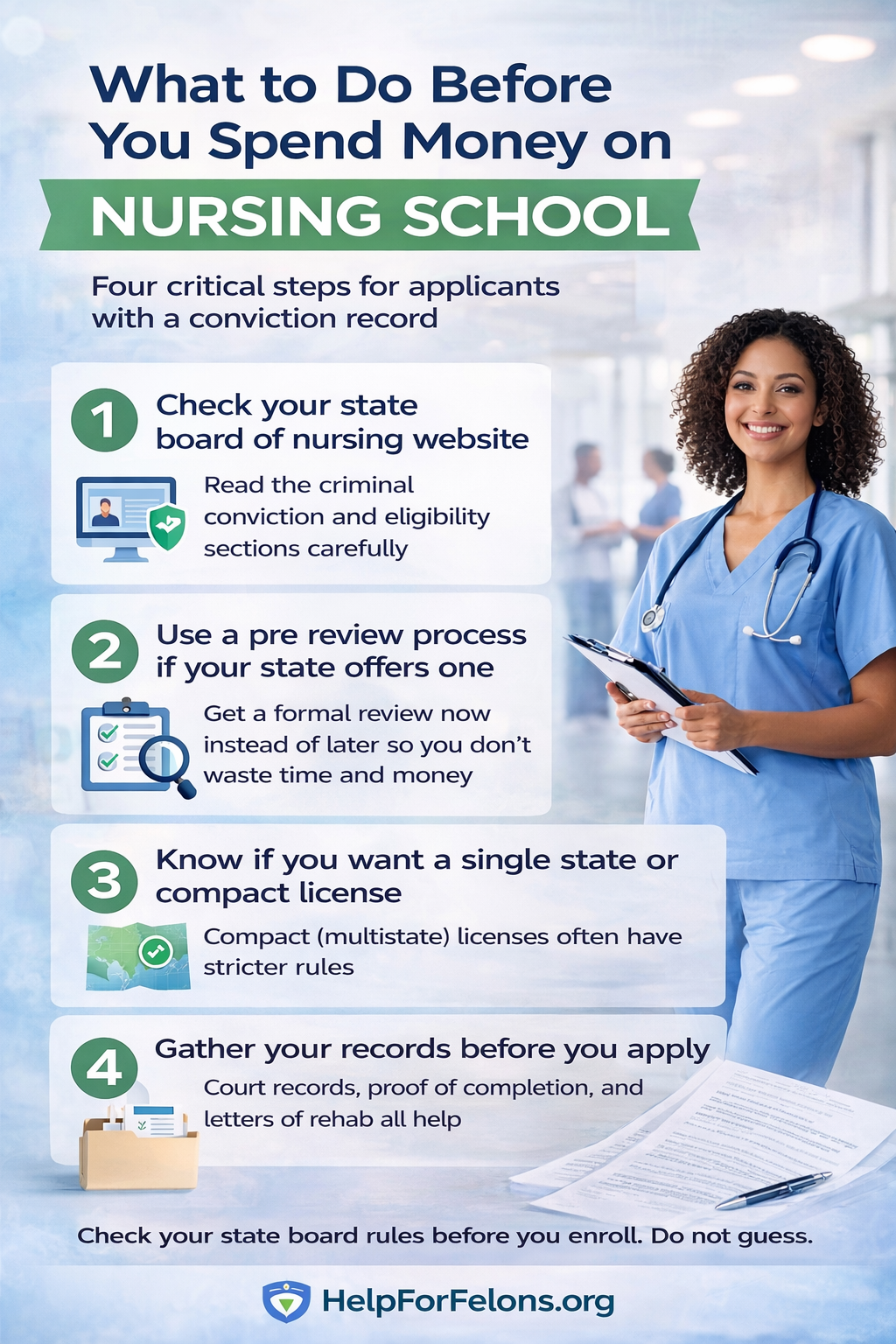
What to do before you spend money on nursing school
Do not guess or hope. Take these steps first:
- Check your state board of nursing website
Read the criminal conviction, disciplinary, and licensure eligibility sections carefully. Rules are not the same everywhere. - Use a pre review process if your state offers one
Texas uses a Declaratory Order process for this exact reason. It is one of the best examples of how to avoid wasting years and tuition money. - Know whether you want a single state license or compact license
These are not the same thing. Compact rules can be stricter. - Gather your records before you apply
Missing documents slows everything down and makes your file look weaker. California says applications that include certified arrest and court records may move faster.
Documents to gather before you apply
Start building your file early. The strongest application usually includes:
- Certified court disposition records
- Certified arrest or investigation records if available
- Proof that probation, parole, restitution, fines, treatment, and all sentence terms were completed
- A detailed personal explanation of what happened
- Proof of rehabilitation
- Letters of recommendation from employers, instructors, counselors, probation officers, or other credible people who know your progress
- Proof of work history, schooling, treatment, or community service
- Expungement, dismissal, pardon, or rehabilitation paperwork if you have it
Example: California specifically lists many of these items and says applications with certified records may have shorter wait times.
How to improve your odds
You cannot change the past, but you can improve your file.
- Be completely honest
Do not hide convictions and do not assume expungement means the board never wants disclosure. California, for example, still requires disclosure of certain expunged convictions on licensure applications. - Show real rehabilitation
The best proof is not talk. It is records. Treatment completion, stable work, school success, clean time, reference letters, and community service matter. - Give the board a complete package
Weak applications make boards do more digging. Strong applications answer concerns before they become delays. California says certified records can help shorten wait times. - Think carefully about state choice
If one state has a hard rule that blocks you, another state may still use a case by case approach. That does not guarantee approval, but it can change your path.
Best alternative healthcare careers if nursing is blocked
If the board tells you no, that does not mean every healthcare path is over. You may still want to look into jobs like:
- Medical billing and coding
- Medical records work
- Home health support roles
- Phlebotomy
- Patient transport
- Dietary or environmental services in healthcare settings
- Some technician roles, depending on the employer and licensing rules
You still need to check background requirements carefully, but these paths may have fewer barriers than nursing licensure.
FAQ
Not nationally. California says there is no one specific conviction that automatically disqualifies every applicant. But some states have harder rules, and some convictions are much tougher than others
Usually this is much harder. Official compact rules say an applicant for a compact license must not have been convicted or found guilty of a felony offense, and compact guidance says felony convictions may disqualify a person from a compact license.
Send the strongest documentation you can get. Certified court records, arrest records, proof of sentence completion, a personal statement, rehabilitation evidence, and strong letters of support can all help.
Yes. Time matters. California says it generally will not take action on convictions older than seven years, with exceptions for serious felonies and certain sex offense registration crimes.
Other Resources for Felons
- Felony Expungement and Record Sealing
- How to Explain Your Criminal Record
- Jobs for Felons
- Most Felon Friendly States
- Background Check Laws Overview
Final takeaway
A felony does not automatically end your chance to become a nurse, but this is one of those careers where you need to be smart before you spend years and money chasing the goal. The best approach is to check your state board rules first, learn whether you are dealing with a single state or compact license issue, and build a clean, honest, heavily documented application.
Disclaimer
Hiring and licensing rules vary by state and can change over time. Information on this page is based on publicly available board guidance and is not a guarantee of school admission, licensure, or employment. Nothing on this site should be considered legal advice.