Last Updated on: March 30, 2026
Quick Answer
Yes, many felons can get small business insurance.
A felony does not automatically stop you from buying insurance for a small business. In most cases, the insurer cares more about what your business does, what risks it creates, what coverage you need, and whether your work requires a license.
Your record can still matter, especially if the conviction involved fraud, theft, financial crimes, or conduct closely tied to the business you want to run. The U.S. Small Business Administration says insurance needs depend on your business risks and legal requirements, and licensing rules vary by business type, state, county, and city.
| Question | Straight answer |
|---|---|
| Can a felon get small business insurance? | Usually, yes |
| Is approval guaranteed? | No |
| What matters most? | Business type, risk level, required coverage, and licensing rules |
| Will a felony always raise your premium? | Not always |
| What should you do first? | Figure out what insurance your business actually needs |
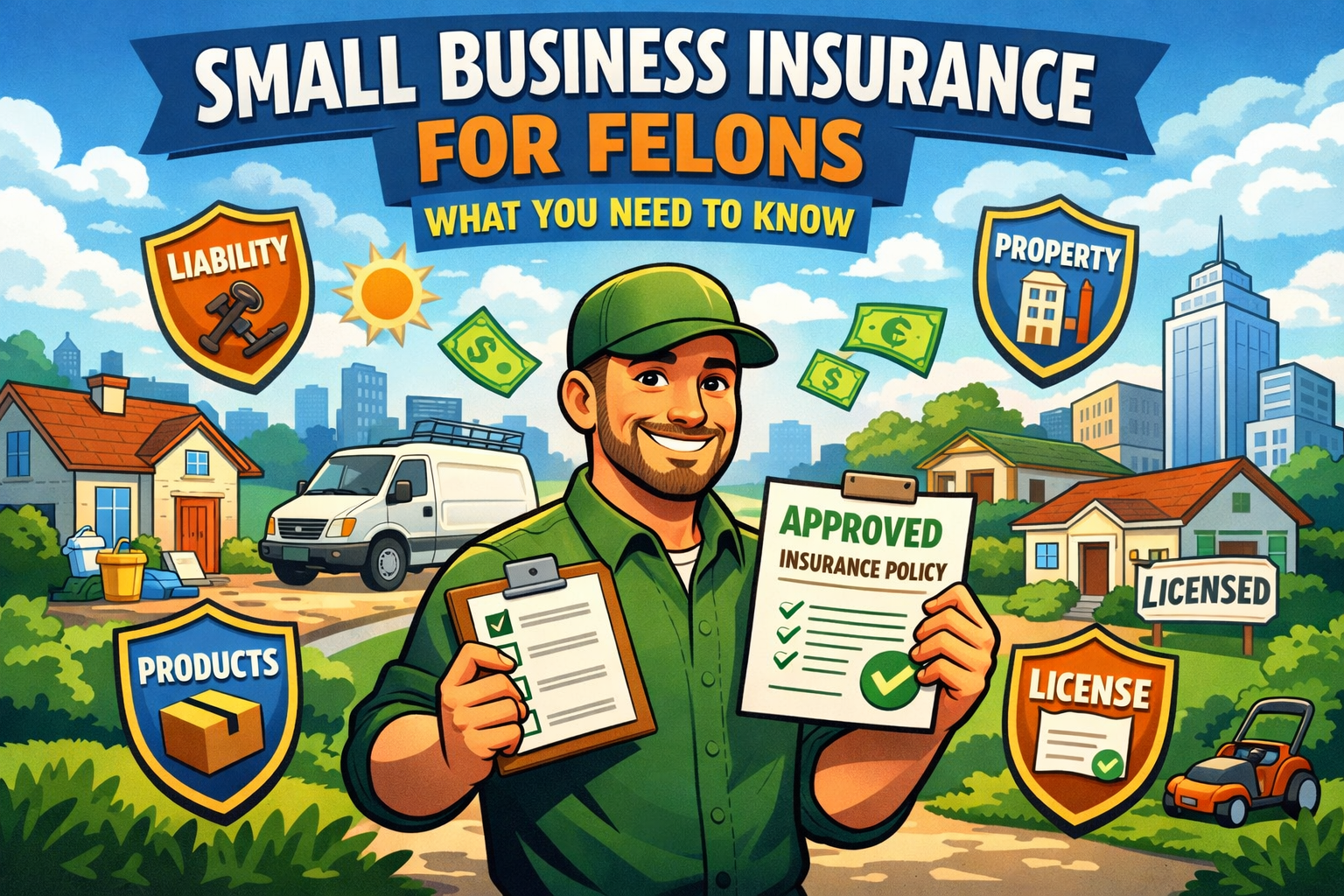
Can a Felon Get Small Business Insurance?
If you are starting a cleaning business, lawn care business, pressure washing business, moving help business, mobile detailing business, online business, or many other common small businesses, a felony record does not automatically block you from getting coverage. What usually matters most is whether the insurer sees your business as a reasonable risk.
That said, some records can create more problems than others. Our Small Businesses For Felons page can walk you though the best options. A conviction for insurance fraud, theft, embezzlement, or other financial dishonesty can be a bigger issue than a conviction that has nothing to do with money, property, or customer trust. The closer your conviction is to the type of work you want to do, the more questions you should expect.
What Matters Most to Insurers?
Insurance companies usually care about the real risk of the business first. That means they may look at:
- what your business actually does
- whether you go into customers’ homes
- whether you handle client money or sensitive information
- whether you have employees
- whether you use vehicles for business
- whether you sell products that could injure someone
- whether your business needs a professional or occupational license
- whether your conviction relates directly to the work
This is why two people with the same record may get very different results. A person starting a basic lawn care business may face fewer problems than a person trying to run a financial services company, a security business, or a regulated professional practice.
Types of Small Business Insurance You May Need
A big weakness of the current page is that it does not explain what readers may actually need to buy.
The SBA says businesses may be legally required to carry certain insurance, especially if they have employees, and it outlines six common types of business insurance small business owners should understand.
| Insurance type | Who may need it | Why it matters |
|---|---|---|
| General liability insurance | Almost any business | Helps cover bodily injury, property damage, lawsuits, and related claims |
| Product liability insurance | Businesses that make, distribute, or sell products | Helps protect against claims involving defective products |
| Professional liability insurance | Service businesses | Important if a customer claims you made a costly mistake |
| Commercial property insurance | Businesses with equipment, tools, or inventory | Helps cover damage, theft, or loss of business property |
| Home based business coverage | Home based businesses | Your homeowners policy may not fully cover business property or liability |
| Business owner’s policy | Many small businesses | Bundles common coverages into one package and may save money |
What Insurance Might Be Required by Law?
Not every policy is optional.
The SBA says the federal government requires businesses with employees to carry workers’ compensation, unemployment, and disability insurance, and states may require additional coverage depending on the business.
That means your first question should not be, “Will they insure me?”
It should be, “What am I legally required to carry for this type of business in my state?”
If you skip that step, you can waste time shopping for the wrong policy.
When a Felony Record Can Make It Harder
A felony can make things harder when the insurer believes your record creates a direct business risk.
That is more likely when:
- the conviction involved fraud, theft, embezzlement, or deception
- you want to handle customer money
- you want access to homes, valuables, or sensitive records
- your business depends heavily on trust, bonding, or professional reputation
- you need a state license for the work
- you are trying to work in the insurance industry itself
This does not mean automatic denial. It means more scrutiny.
Some businesses will be easier to insure because the risk is simpler and easier to understand. Others will be harder because the insurer may worry about claims, customer complaints, dishonesty risk, or licensing barriers.
Insurance Problems and Licensing Problems Are Not the Same Thing
This is where many people get confused.
You may be able to buy insurance for a business and still run into trouble getting the license needed to legally operate that business.
The SBA says most small businesses need some combination of federal, state, county, or city licenses and permits, and the rules vary by business activity and location. It also notes that states regulate a broad range of business activities, including construction, plumbing, restaurants, retail, auctions, farming, dry cleaning, and vending.
So sometimes the real problem is not the insurance company. The real problem is that the business itself is regulated.
That is especially important if you are looking at:
- trades that require licensing
- financial services
- security related work
- health related services
- childcare or elder care
- transportation businesses
- any business where the state closely reviews criminal history
Best First Businesses for Fewer Insurance Problems
In general, simpler businesses with lower claim risk and fewer licensing issues may be easier places to start.
Examples include:
- lawn care
- junk removal
- house cleaning
- pressure washing
- moving help
- basic painting
- mobile car detailing
- simple online service businesses
- reselling businesses with proper product and tax compliance
These businesses are not guaranteed approvals, but they are usually easier to explain to an insurer than a business involving client funds, financial advice, medical work, security work, or highly regulated services.
How to Shop for Coverage Without Wasting Money
The SBA gives a simple process to buy insurance; assess your risks, find a reputable licensed agent, shop around, and reassess your coverage every year.
Use that process in a practical way:
1. Figure out what your business actually does
Be able to explain your work clearly in one or two sentences.
2. Know what property and risk you need to protect
Think about tools, equipment, inventory, vehicles, client property, and injury risk.
3. Check your licensing rules first
Do this before buying anything. If the work is regulated, solve that issue early.
4. Talk to more than one agent
Do not stop after one quote or one rejection.
5. Be honest about your record
Lying will usually hurt you more than disclosure.
6. Ask what policy they are quoting
Do not say yes to coverage you do not understand.
7. Review coverage every year
As your business grows, your risks change.
What to Tell Insurance Agents
Keep it simple and honest. A strong approach sounds like this:
“I am starting a small business. Here is exactly what the business does. Here is whether I have employees, vehicles, equipment, or customer property involved. I also want to be upfront that I have a felony on my record. It was for [general category if needed], and I want to know what coverage is available for this business.”
That approach is better than oversharing, hiding details, or being vague about the business.
What to Do If You Are Denied
Do not assume one denial means you are done.
Take these steps:
- Ask whether the denial was based on your record, the business type, the licensing issue, or something else.
- Ask whether they are denying all coverage or only a specific policy.
- Get quotes from other agents or carriers.
- Ask what kind of documentation would help.
- Be ready to explain time passed, rehabilitation, and how the business reduces risk.
- Check whether the real problem is a required license, not insurance itself.
- Consider changing your business model to something lower risk.
A denial does not always mean “felony.” Sometimes it means the carrier does not like startups, home based businesses, a certain trade, or a specific claims exposure.
Common Mistakes to Avoid
- buying coverage before checking licensing rules
- assuming every business needs the same policy
- only getting one quote
- hiding your criminal history
- not asking what is excluded
- forgetting to insure tools, equipment, or vehicles
- assuming your homeowners policy covers a home based business
- not updating your policy as the business grows
Remeber
Felons can often get small business insurance without much pushback.
The best question to ask yourself is what kind of business are you starting, what risks does it create, and what rules apply to that business where you live.
For many people, the easiest path is to choose a simple business with lower risk, check licensing rules first, shop around with multiple agents, and be honest about their record from the start.
Other Resources
- Loans For Felons
- Grants for Felons
- Best Careers for Felons
- Felony Expungement
- Background Check Laws Overview
Disclaimer
Having a felony does not automatically prevent someone from getting small business insurance, but approval, pricing, and coverage options vary by company, business type, state rules, and the facts of the conviction. Licensing rules may create separate barriers even when insurance is available. Information on this page is for general educational purposes only and is not legal, financial, or insurance advice.