
Last Updated on: March 26, 2026
If you have a felony on your record and you are thinking about becoming a truck driver, the good news is this: it may still be possible. A felony does not automatically stop someone from becoming a truck driver in every case. But this is also not a career where you should spend money blindly and hope it works out. FMCSA says a felony does not automatically disqualify a CDL driver unless the offense involved use of a motor vehicle. At the same time, trucking companies, insurers, state licensing rules, and medical requirements can still create real barriers.
This guide will help you figure out whether trucking is a realistic path before you pay for CDL school.
Quick Answer
Yes, many felons can become truck drivers, but not everyone should move forward right away without proper research. Your chances usually depend on 4 things:
- Whether you can legally get a CDL in your state
- Whether you can pass the DOT medical exam
- How long it has been since your release
- Whether a trucking company and its insurer will approve you
A felony record alone does not automatically bar someone from operating a commercial motor vehicle under FMCSA rules unless the offense involved use of a motor vehicle. But licensing and hiring are not the same thing, and both matter.
Who This Page Is For
This page is for you if:
- You want to know whether you can realistically get into trucking with a felony
- You are trying to avoid wasting money on CDL school
- You want to know what problems matter most before applying
- You want a practical step by step path instead of hype
Start Here Before You Pay for CDL School
Before you spend money, check these in this order:
- Make sure your regular driver’s license is valid
- Check your states CDL eligibility rules
- Make sure you are not disqualified because of a felony involving use of a motor vehicle
- Think honestly about any medical issues that could affect a DOT physical (High blood Presure, Diabetes, Color Blindness, Etc..)
- Contact trucking companies before school and ask about your felony record
- Ask whether your charge type and timeline would be approved by their insurance
- If you may want a HazMat endorsement, some felonies disqualify you.
That order matters because many people pay for training first and only later find out they have a licensing, medical, or a hiring problem.
Can a Felon Get a CDL?
In many cases, yes.
FMCSA guidance says a driver who has been convicted of a felony is not necessarily disqualified from operating a commercial motor vehicle. The main federal warning is that the offense can be disqualifying if it involved use of a motor vehicle, whether it was a CMV or a non CMV. States also check licensing databases and the National Driver Registry when a person applies for or renews a CDL.
That means you should think of this in 3 separate layers:
- CDL eligibility
- Medical qualification
- Employer hiring approval
A person might be legally able to get a CDL and still have trouble getting hired.
When a Felony Can Create Bigger Problems
Some records usually create more difficulty than others. Examples that may create bigger problems include:
- Felonies involving use of a motor vehicle (This is a big deal)
- Recent violent felonies
- Theft or fraud related offenses
- Drug trafficking related offenses
- Multiple felony convictions
- Serious driving related offenses such as DUI history
- Charges that make certain endorsements impossible (Hazmat)
That does not mean every company will say no. It means your odds may be lower, especially if the record is recent or tied to safety, dishonesty, or transportation.
Age Rules Matter More Than People Realize
This is one area where a lot of older content gets the rule wrong.
For interstate commerce, FMCSA says a person must be at least 21 years old to drive a CMV/Commercial Motor Vehicle. FMCSA also says drivers can obtain a CLP or CDL at age 18 for intrastate driving under state rules, and 49 states plus Washington, DC currently allow 18, 19, and 20 year old drivers to operate in intrastate commerce with a CLP or CDL.
So the simple version is:
- Age 21 or older usually opens the door to interstate trucking (OTR/Long Distance)
- Age 18 to 20 may still allow intrastate CDL driving depending on the state and situation
If you are under 21, do not assume trucking is impossible. But do not assume you can do long haul interstate work either.
Your DOT Medical Exam Can Stop the Process Fast
A lot of people focus only on the felony and forget about the physical.
FMCSA’s current Medical Examiner’s Handbook, January 2024 edition, replaced previous handbook editions and is the current federal guidance for medical examiners. FMCSA guidance also states that when blood pressure is greater than 180/110, the driver is disqualified until it is controlled, while lower ranges may allow shorter certification periods.
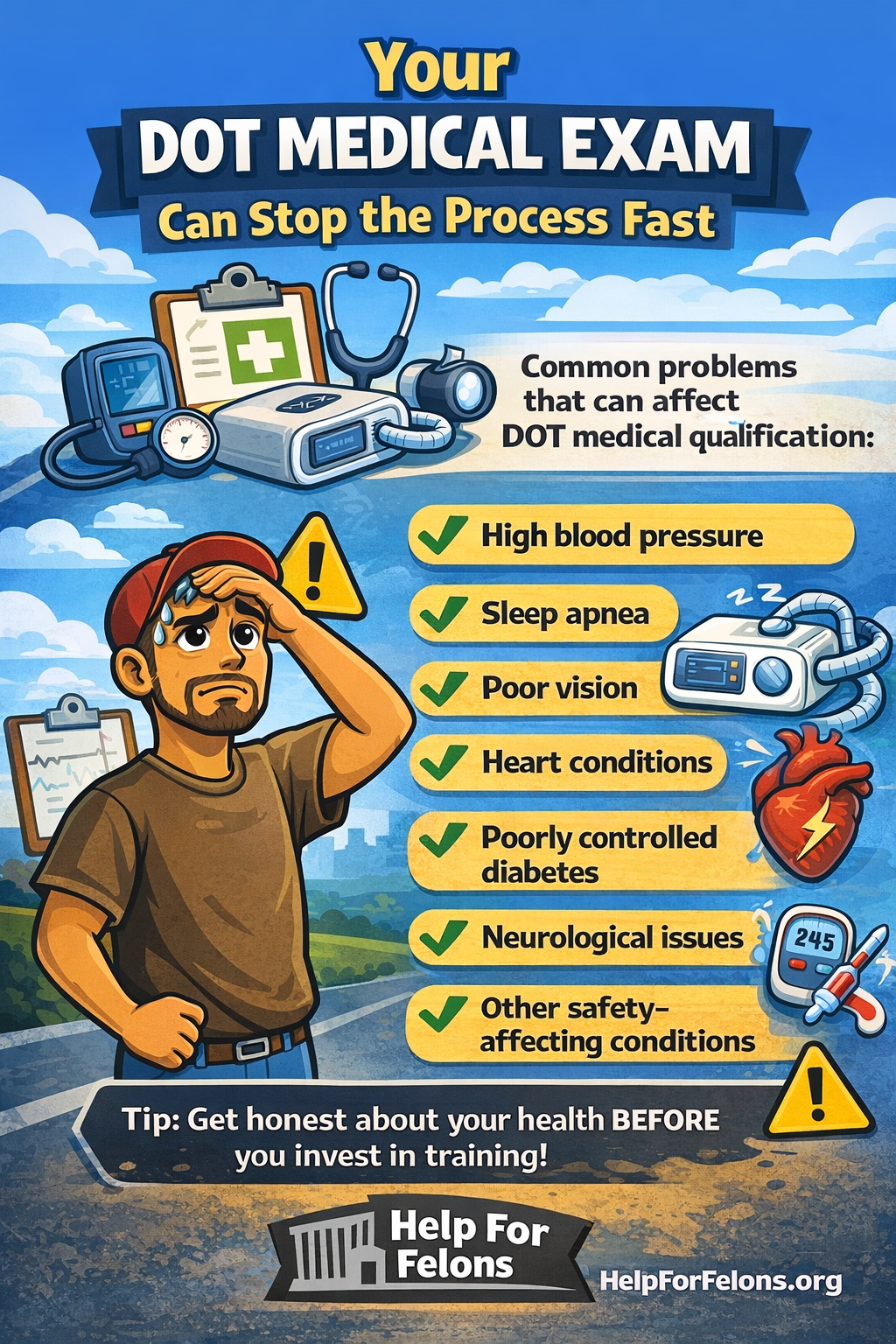
Common problems that can affect DOT medical qualification include:
- High blood pressure (Even elevated can shorten how long you qualify for)
- Sleep apnea
- Poor vision that is not corrected adequately
- Certain heart conditions
- Poorly controlled diabetes
- Some neurological issues
- Other conditions that could affect safe operation
This is why one of the smartest things you can do is get honest about your health before you invest in training.
Do Trucking Companies Hire Felons?
Some do. Some do not. Most are not all the same.
The truth is that company policy varies a lot. There is no one national rule that says all trucking companies reject felons after a certain type of conviction or after a certain number of years. That is why broad claims like “no one hires within 5 years” are not reliable enough on their own.
What companies usually care about most:
- How recent the conviction was
- Whether the offense involved violence, theft, drugs, or a vehicle
- Whether there are multiple convictions
- Whether your recent work history is stable
- Whether your recent driving record is clean
- Whether the company’s insurer will approve you
In trucking, the insurance side matters a lot. Even if a recruiter likes you, the insurer may still block the hire.
Insurance Can Be the Real Gatekeeper
This is one of the most important things to understand.
A company may be open to hiring someone with a record, but if its insurance provider views your background or driving record as too risky, that can still end the process. This is one reason why the same applicant may get a yes from one company and a no from another.
That is also why you should talk to multiple carriers before spending money on school.
HazMat Is a Separate Issue
A person may be able to get a regular CDL and still be blocked from a Hazardous Materials endorsement.
TSA says HazMat endorsement applicants are screened for disqualifying criminal offenses and other factors, and TSA lists permanent and interim disqualifying offenses. TSA also has a waiver process in some cases.
So if your long term goal is HazMat, do not assume that getting a CDL means HazMat will be available too.
Best Path to Become a Truck Driver With a Felony
Here is the smartest order to follow. This will save you a ton of money if things don’t work out.
Step 1. Make sure your regular license is valid
If your regular license is suspended, revoked, or full of serious issues, fix that first.
Step 2. Check your state CDL rules
CDLs are issued through the state, and states run checks to make sure the applicant is not disqualified elsewhere and does not already hold a CDL in another jurisdiction.
Step 3. Be honest about your record
Write down:
- Exact charge
- Conviction date
- Release date
- Probation or parole status
- Whether a motor vehicle was involved
- Whether there were multiple cases
You need that information before you call recruiters.
Step 4. Talk to trucking companies before school
Call recruiters and ask directly:
- Do you hire people with felonies?
- Do you review cases individually?
- Does my charge type usually pass?
- How long since conviction or release do you usually want?
- Would your insurance likely approve me?
- Do you offer pre hire letters or pre approval?
Step 5. Take medical concerns seriously
If you think your health could be a problem, deal with that first. The DOT medical exam can kill the plan faster than the felony issue in some cases.
Step 6. Only then think about CDL school
Truck driving schools often accept students even when later employment will be hard. That means school approval is not the same as job approval.
Step 7. Apply widely
Do not talk to one company and stop. Different carriers can have very different rules.
Should You Apply Before You Have a CDL?
In many cases, yes.
That can be one of the smartest moves you make. Most trucking companies are willing to talk with applicants early, and some may even give you a pre hire style indication that you may qualify once the rest of the process is complete. It is not a guarantee, but it can help you avoid wasting money.
Is Local Trucking or OTR Better for Felons?
It depends, but many people with records find that larger over the road carriers may be more realistic for a first break.
- Big carriers hire at scale
- They often have more structured recruiting systems
- Some local jobs want experience right away
- Local jobs may be more competitive
- Specialized work can come with extra restrictions
- Many are self insured
That does not mean local work is impossible. It means your first opportunity may not look like your ideal long term trucking job.
What to Expect in Your First Year
Truck driving can be a real path to decent income, but the job is not easy.
BLS says the median annual wage for heavy and tractor trailer truck drivers was $57,440 in May 2024. BLS also projects 4 percent job growth from 2024 through 2034, with about 237,600 openings each year on average.
But the first year often includes:
- Time away from home
- Long hours
- Learning backing, trip planning, logs, inspections, and trip timing
- Stress from weather, traffic, and schedules
- Lower pay at the start compared with experienced drivers
- A lot of adjustment if you have never worked alone for long stretches
For the right person, trucking can still be one of the better career paths available without a college degree.
Signs Trucking May Be a Good Fit for You
- You are comfortable working alone
- You can handle long hours and routine
- You want a practical career with steady openings
- Your health is solid enough for DOT certification
- Your record is old enough or limited enough that companies may review it fairly
- You are willing to start with the company that gives you a shot, not necessarily the one you dream about
Signs You Should Pause Before Spending Money
- Your offense involved use of a motor vehicle
- Your license is suspended or revoked
- You have serious untreated medical issues
- You are counting on HazMat without checking TSA rules
- You have not spoken to any recruiters yet
- You are assuming school approval means job approval
Remeber
If you have a felony record, trucking may still be one of the better career paths available to you. But the right move is not to rush into CDL school and hope for the best.
The right move is to:
- Check your license
- Check your state rules
- Be honest about your record
- Talk to recruiters first
- Take medical issues seriously
- Only pay for training after you know you have a realistic shot
That approach can save you money, time, and a lot of disappointment.
Other Resources for Felons
- Truck Driving Companies That Hire Felons
- High Paying Jobs for Felons
- Felony Expungement
- Background Check Laws Overview
- Jobs for Felons
- Financial Help for Felons
Disclaimer
Hiring policies vary by company and can change over time. State CDL rules, insurance standards, endorsement rules, and medical qualification issues can also change. Information on this page is for general educational purposes only and is not legal advice. Always verify licensing questions with your state CDL agency and official federal guidance.